

Signs your pool needs resurfacing
Sarasota Pool Refinishing is a guide run by Terragroupe, LLC. We do not resurface pools or do any pool work, and we are not taking requests yet. A licensed pool contractor does this work, and we are lining one up.
A pool surface usually needs work when it turns rough, flakes, stains for good, sheds stones or keeps growing algae in the same spots 1. Cracks and water loss are different: find the cause before anyone talks about a new finish. The Pool Surface Condition Check scores what you see.
Sarasota Pool Refinishing is a guide run by Terragroupe, LLC. We do not resurface pools or do any pool work, and we are not taking requests yet. A licensed pool contractor does this work, and we are lining one up.
Last reviewed October 18, 2026 against the cited sources.
Updated . Sources
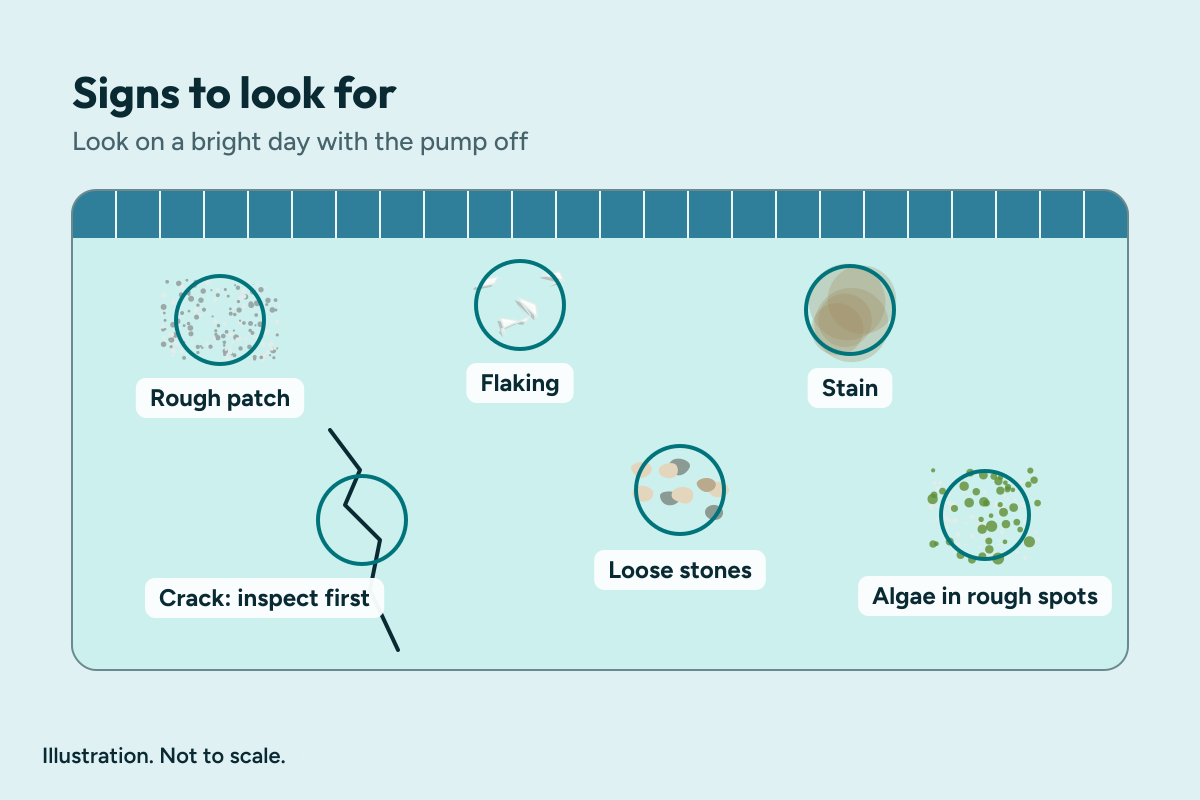
Signs you can see or feel
Swimply's 2026 guide lists the signs below 1. Look on a clear, bright day with the pump off so the water is still.
Rough patches
Run your palm over the walls, steps and benches. A surface that snags a swimsuit or scrapes a foot has worn through its smooth top layer. Rough spots also give algae a place to hold on.
Flaking or peeling
Thin pieces of plaster that lift or chip away mean the top coat is coming loose. It often starts on steps and benches, where feet and water movement are heaviest.
Stains and blotchy color
Some stains clean off with brushing and water care. Stains that will not scrub off, or color that has gone patchy, usually sit in the surface itself.
Loose aggregate
In a quartz or pebble finish, grit or stones that come away in your hand point to a worn surface. A few near the steps may be a repair. Large areas point to a resurface.
Signs that need a cause found first
Cracks
Swimply notes that visible cracks can be structural and call for an inspection 1. Do not let a new finish cover a crack nobody has explained. A licensed contractor should inspect it first.
Water loss with no clear cause
Every pool loses some water to the sun and splashing. If the level keeps dropping faster than that, ask for a leak check. A new surface does not fix a leaking pipe or fitting.
Algae that keeps coming back
If algae returns to the same rough spots after cleaning, the surface may be the problem 1. Check your water care too, so you fix the right thing.
Water that will not stay balanced
Chemistry that is hard to hold can come from a worn surface 1. It can also come from the fill water, the equipment or the routine. Rule those out with your pool service first.
How old is too old?
Age alone does not decide it. National guides give plaster 7-10 years (national guide range)1, quartz 10-15 years (national guide range)1 and pebble 15-25 years (national guide range)1. A pool past those ranges with no signs may be fine for now. A younger pool with several signs may not be.
If you do not know when the pool was last resurfaced, the signs matter more than the date.
What to do next
- Take photos of each sign in daylight, with something for scale.
- Score what you see with the surface check.
- If you see cracks or water loss, ask a licensed contractor to inspect first.
- Compare finishes and read the license guide before you sign anything.
Facts used in this guide
| Fact | Value | Source |
|---|---|---|
| Swimply's 2026 guide gives plaster (marcite) pool finishes a typical life of 7 to 10 years.A national guide range, not a Florida or Sarasota figure. Water care and use change how long a finish lasts. | 7-10 years (national guide range) | [1] February 9, 2026 |
| Swimply's 2026 guide gives quartz pool finishes a typical life of 10 to 15 years.A national guide range, not a Florida or Sarasota figure. Water care and use change how long a finish lasts. | 10-15 years (national guide range) | [1] February 9, 2026 |
| Swimply's 2026 guide gives pebble pool finishes a typical life of 15 to 25 years.A national guide range, not a Florida or Sarasota figure. Water care and use change how long a finish lasts. | 15-25 years (national guide range) | [1] February 9, 2026 |
| Bob Vila's pool resurfacing guide says a plaster finish lasts about 10 years.An older national guide (2022), not a Florida figure. | about 10 years (national guide figure) | [2] July 26, 2022 |
| Bob Vila's pool resurfacing guide says a quartz finish lasts about 12 years.An older national guide (2022), not a Florida figure. | about 12 years (national guide figure) | [2] July 26, 2022 |
| Bob Vila's pool resurfacing guide says aggregate finishes (such as pebble) last 10 to 20 years.An older national guide (2022), not a Florida figure. | 10-20 years (national guide range) | [2] July 26, 2022 |
| Swimply's 2026 guide lists signs that a pool surface needs resurfacing: rough patches, flaking or peeling plaster, stains that will not scrub off, visible cracks, blotchy color, loose aggregate, algae that keeps coming back in rough spots, water loss with no clear cause, and water chemistry that is hard to balance. It says visible cracks can be structural and call for an inspection.A national guide's list. A contractor still has to look at your pool. | 9 signs, cracks need an inspection list | [1] February 9, 2026 |
| Pebble Technology International (Pebble Tec) says its pebble finish lasts over 20 years with proper maintenance and pool chemistry, and often up to three decades with good care (vendor).A manufacturer's claim from a company that sells pebble finishes, not an independent or Florida-specific figure. | 20+ years (manufacturer claim) | [3] undated (retrieved October 19, 2026) |
| On the same page, Pebble Technology International says plaster needs resurfacing every 5 to 10 years (vendor, a pebble maker describing a competing finish).A manufacturer's claim about a competing finish, not an independent or Florida-specific figure. | 5-10 years (manufacturer claim) | [3] undated (retrieved October 19, 2026) |
| Pebble Technology International's plaster-versus-pebble page gives plaster a 'relatively short lifespan' of 5 to 15 years and pebble 20-plus years with proper chemistry and maintenance (vendor). It gives no lifespan for quartz.A manufacturer's claim, not an independent or Florida-specific figure. | 5-15 years (manufacturer claim) | [4] undated (retrieved October 19, 2026) |
| Pebble Tec's start-up guide says that during the first 28 days the finish develops most of its durability. Some white plaster dust releases into the water and raises pH and calcium hardness, and not testing, brushing and balancing the water leaves stains, blotchy color or roughness. It also says to wait 28 days before judging the final color.Manufacturer start-up guidance for its own finishes; follow the written instructions your installer gives you. | 28 days (manufacturer procedure) | [5] 2024-05 (PDF creation date; file name dated 1.20.22) |
| Pebble Tec's start-up guide says to test the source water before filling, fill without interruption with clean potable water to the middle of the tile line or skimmer face, and not to fill with soft water (tell the installer if hose bibs supply soft water). It says stopping the flow causes a waterline mark, nobody including pets enters during filling, and no salt is added for the first 28 days.Manufacturer guidance. Ask your installer whether your tap water needs changes to the start-up plan. | do not fill with soft water; no stopping the fill; no salt for 28 days text (manufacturer procedure) | [5] 2024-05 (PDF creation date; file name dated 1.20.22) |
| Pebble Tec's start-up guide says to run the pump and filter continuously after the fill (at least 5 days, or 7 days or until no plaster dust remains, with a 72-hour minimum, in its checklist), brush the whole surface at least twice daily, and not use wheeled pool cleaners for 28 days. It says to keep chlorine out for 48 hours, keep the pool heater off for the first 14 days, and use nylon brushes only on its PebbleFina and PebbleBreeze finishes and nylon, combo (nylon and stainless steel) or polypropylene brushes on its other finishes. | brush at least twice daily; pump continuous 5 to 7 days; heater off 14 days text (manufacturer procedure) | [5] 2024-05 (PDF creation date; file name dated 1.20.22) |
| Pebble Tec's start-up range for the first 28 days is pH 7.0-7.4, total alkalinity 80-100 ppm, calcium hardness 150-250 ppm, total dissolved solids 400-600 ppm, free chlorine 1-3 ppm, cyanuric acid 20-30 ppm and a Langelier index between -0.3 and 0.3. After 28 days its ongoing range is pH 7.2-7.6, calcium hardness 200-300 ppm and cyanuric acid 20-30 ppm. | pH 7.0-7.4; TA 80-100; CH 150-250 (first 28 days) text (manufacturer ranges) | [5] 2024-05 (PDF creation date; file name dated 1.20.22) |
| The National Plasterers Council start-up card says to test fill water for pH, total alkalinity, calcium hardness and metals, and to fill to the middle of the skimmer without interruption, as rapidly as possible, with clean potable water to help prevent a bowl ring and shrinkage cracking. It says to put a cloth on the hose end in the deepest area, keep other water out and keep people and pets out during the fill, and start the filtration system as soon as the pool is full.Industry-body recommendation, not a rule. Your installer's written start-up sheet comes first. | fill without interruption; start filtration when full text (industry-body procedure) | [6] 2021 (copyright 2021; PDF created 2021-11-22; hosted by a plastering company, nptpool.com, not npconline.org) |
| The NPC start-up card says to brush the whole plaster surface thoroughly at least twice daily on days 1 to 3 (and repeat the brushing and continuous pump running each day through day 7), run the pump and filter continuously for seven days or until the dust is gone (at least 72 hours), and keep wheeled cleaners out for 28 days. After day 7, once the dust is removed, brushing can be limited to visible debris or when chemicals are added. | brush at least twice daily; pump continuous 7 days text (industry-body procedure) | [6] 2021 (copyright 2021; PDF created 2021-11-22; hosted by a plastering company, nptpool.com, not npconline.org) |
| The NPC start-up card sets day 1 alkalinity at 80-100 ppm and pH at 7.2-7.6, steps calcium hardness up from 80-100 ppm on day 1 to 100-150 ppm on day 2 and at least 200 ppm by days 4-7, adds chlorine to 1.5-3.0 ppm on day 3 (none for the first 48 hours) and begins cyanuric acid at 30-50 ppm on days 4-7. It says not to run the pool heater until the water is balanced and no plaster dust remains. | no chlorine for 48 hours; CH at least 200 ppm by day 4-7 text (industry-body procedure) | [6] 2021 (copyright 2021; PDF created 2021-11-22; hosted by a plastering company, nptpool.com, not npconline.org) |
| The NPC start-up card says new plaster is especially prone to staining, scaling and discoloration in its first 28 days, and that salt-water pools should not add salt within the first 30 days. After the start-up it keeps the Langelier index between 0.0 and +0.3, with free chlorine 1-3 ppm, calcium hardness 200-400 ppm, cyanuric acid 30-50 ppm and pH 7.2-7.6. | 28 days sensitive; no salt for 30 days; LSI 0.0 to +0.3 text (industry-body procedure) | [6] 2021 (copyright 2021; PDF created 2021-11-22; hosted by a plastering company, nptpool.com, not npconline.org) |
Pool Surface Condition Check
Look at the pool on a bright day with the pump off, then answer each question. The result shows a stage and the answers that counted most. It is a starting point, not a price and not a diagnosis.
Start the Pool Surface Condition CheckSarasota Pool Refinishing is a guide run by Terragroupe, LLC. We do not resurface pools or do any pool work, and we are not taking requests yet. A licensed pool contractor does this work, and we are lining one up.
Questions people ask
Can I just patch the rough spots?
Sometimes. A small damaged area can often be repaired. If the wear is spread across the pool, a patch may not blend in or last. Ask the contractor to explain the choice in writing.
Is a rough pool surface dangerous?
It can scrape skin and snag swimsuits. We cannot judge your pool from here. If the surface is breaking up or cracked, keep people off the damaged area and have a licensed contractor look at it.
Sources
- Swimply Host Blog, How Much Does It Cost to Resurface a Pool? 2026 Guide, February 9, 2026
- Pool Resurfacing Cost: Project Budgeting Guide - Bob Vila, July 26, 2022
- How long does a pebble pool finish last? (Pebble Technology International), undated (retrieved October 19, 2026)
- Plaster vs pebble swimming pool finishes (Pebble Technology International), undated (retrieved October 19, 2026)
- Recommended Start-Up and Maintenance Procedures for All PebbleTec Brand Pool Finishes (Pebble Technology International), 2024-05 (PDF creation date; file name dated 1.20.22)
- NPC Recommended Start-up Procedures card (National Plasterers Council), 2021 (copyright 2021; PDF created 2021-11-22; hosted by a plastering company, nptpool.com, not npconline.org)